Time: 4pm-9pm (5)
Hours completed (IST): 135.5/135
Hours completed (Kara Robinson): 15/15
Accumulated on-site hours: 150.5/150
The goal for today is to finalize the LibGuide so that Tammy can approve it and it can go live. Most everything from my original plan came together except the video. With everything else going on at the moment it just was not going to work out; however, I felt it was necessary to have some kind of visual or interactive element in the guide. After thinking about it for some time I chose to paste the text of an article from a news site into the guide. Then, underneath, I used the Libguides survey tool to create a test element where students could read the article and the choose whether they think that the article was a legitimate or satirical news story. So that they could get an immediate response to their guess, I had the survey call out to a Google Doc file that explained which it was and why, and it also gave the link for the original story. I feel this activity is a good alternative for an instructional video and, with it creating a more active environment, may actually prove better than the passive nature of watching. I had some concerns about copyright issue, however, but left it in place until I could consult with Tammy. I did change the guide's status to private.
[Update]
Tammy was really concerned about copy/pasting material into the guide. She asked if I could just provide a link to the site or use some other solution that would not err the library on the wrong side of copyright law. I had been playing around with iframes quite a bit in constructing this blog and my ePortfolio, so I decided to give that a shot. I discovered that LibGuides allowed the use of the iframe HTML code and use that to embed the news story from the external web site into the guide.
I then rechecked the library's policy for LibGuide construction and found that I could modify the page from three columns to two as long as I maintained the guide's presets. I removed the right column which made reading the story in the iframe much easier. Afterwords, I added a link underneath the iframe in case a student was using a browser that does not support iframes. I also modified the instruction for the exercise and the Google Doc that appears after they answer the question so it better explains how to assess the story as a web page.
Finally, a colleague in the library expressed an interest in using the LibGuide for his journalism students so I asked if he would like to be added as a co-owner so that he could edit and update the guide after I graduated.
I will have Tammy review the changes that I made before changing the status.
Here is a link to the LibGuide.
*This is the last daily log entry for my practicum.
Thursday, April 23, 2015

April 16, 2015 (Thursday)
Time: 8:30am-11:30am; 2pm-3:30pm (4.5)
Hours completed (IST): 130.5/135
Hours completed (Kara Robinson): 15/15
Accumulated on-site hours: 145.5/150
Today I observed two BI sessions with Tammy. The first was an outreach session with a local high school and the second was with a group of Ph.D. candidates in the English department. I did not actively participate in either because the former was more specific to Tammy's expertise (British Poetry) and the latter was my first time with a group of Ph.D.-level students. Typically, it has always been our procedure that I only observe the first instance of an instruction session.
The first session was similar to the outreach that we do high schools except that all the example searches and discussion of databases was geared more toward the topic. The session with the graduate students was interesting to observe as Tammy was able to introduce skills and tips that were much more in-depth than the session that I have observed or participated in. On one of her handouts for the graduate students Tammy used a series of Venn diagrams to explain how Boolean Operators work which I thought was a great way to visualize the information. The Ph.D. students were much more interactive and excited to discuss aspects of Tammy's presentation which made it difficult to fit in everything she planned to talk about. No matter what it is so important to properly plan a lesson but, just as important, it is necessary to react to the class and follow their interests. In other words, plan but don't be too rigid.
After the session, as Tammy and I discussed how things went I suggested that the Venn diagram may work well with undergraduates to help them visualize what Boolean Operators are doing. She said that it was something that she used to include and was meaning to add back into the handouts for undergraduates. Tammy also reminded me that my approach of explaining it as "and is less, but or is more" is also effective. I like the idea of presenting information in a way that students can learn through the modes that learn best, so in my own sessions I would likely use the Venn diagram on handouts and also explain how or is more.
Hours completed (IST): 130.5/135
Hours completed (Kara Robinson): 15/15
Accumulated on-site hours: 145.5/150
Today I observed two BI sessions with Tammy. The first was an outreach session with a local high school and the second was with a group of Ph.D. candidates in the English department. I did not actively participate in either because the former was more specific to Tammy's expertise (British Poetry) and the latter was my first time with a group of Ph.D.-level students. Typically, it has always been our procedure that I only observe the first instance of an instruction session.
The first session was similar to the outreach that we do high schools except that all the example searches and discussion of databases was geared more toward the topic. The session with the graduate students was interesting to observe as Tammy was able to introduce skills and tips that were much more in-depth than the session that I have observed or participated in. On one of her handouts for the graduate students Tammy used a series of Venn diagrams to explain how Boolean Operators work which I thought was a great way to visualize the information. The Ph.D. students were much more interactive and excited to discuss aspects of Tammy's presentation which made it difficult to fit in everything she planned to talk about. No matter what it is so important to properly plan a lesson but, just as important, it is necessary to react to the class and follow their interests. In other words, plan but don't be too rigid.
After the session, as Tammy and I discussed how things went I suggested that the Venn diagram may work well with undergraduates to help them visualize what Boolean Operators are doing. She said that it was something that she used to include and was meaning to add back into the handouts for undergraduates. Tammy also reminded me that my approach of explaining it as "and is less, but or is more" is also effective. I like the idea of presenting information in a way that students can learn through the modes that learn best, so in my own sessions I would likely use the Venn diagram on handouts and also explain how or is more.
April 14, 2015 (Tuesday)
Time:10:30am-3:30pm (5)
Hours completed (IST): 126/135
Hours completed (Kara Robinson): 15/15
Accumulated on-site hours: 141/150
After speaking with my on-site supervisor and showing her what I accomplished so far with the LibGuide it was suggested, as I thought it may be, that I was going in the wrong direction. Namely, the policy for guides at KSU is to keep them from becoming too weighed down in text. Because I was designing this as both a source of information and as a quasi-standalone lesson, I was including far too much text. Tammy commented that what I had written was good and that I could probably add it to a blog and link out to it. That way it was still a resource students could look at and it would bring my LibGuide in line with the standards.
This meant completely gutting two pages. The Home and Satire in Brief pages remained unchanged. The latter included about 250 words of text which I felt was central to students becoming grounded in the topic. Where I originally planned to have about five pages, I cut that number back to four. The third page will now be titled Identifying Satirical News. For this page I am planning a short video using screen-capture technology that will give a guided tour of a satirical news site and show how difficult it can sometimes be to locate disclaimer information. The Resources page will be split into two with one including a list of free and academic resources about satirical news and the second will provide a list of online satirical news sites.
After developing a new strategy, I set about making changes. I opted to take this blog, which was originally just meant to house my daily logs, and open it up to act as a professional blog. I reworked some of the text from my LibGuide and used it to create a post that I could link to. I then set about preparing to make the video to embed in the guide. I began by experimenting with several free screen capture tools. While I have previous worked with Screencast-O-Matic, I felt that the free version lacked some valuable feature and chose instead to go with NCH Software's Debut capture software.
With the software decided, I now had to determine a host. Initially, I planned to use Kent State's video hosting service KSUtube; however, I had concerns about accessibility with doing a video. After some research I discovered that YouTube provides a transcription service for people who upload videos. I ended the day by doing a few test runs with Debut and writing up a general script.
While I think the video is a good fit for my goal and I had satisfied some of my concerns about accessibility, I worry that making the video may take more time than I have to invest.
Hours completed (IST): 126/135
Hours completed (Kara Robinson): 15/15
Accumulated on-site hours: 141/150
After speaking with my on-site supervisor and showing her what I accomplished so far with the LibGuide it was suggested, as I thought it may be, that I was going in the wrong direction. Namely, the policy for guides at KSU is to keep them from becoming too weighed down in text. Because I was designing this as both a source of information and as a quasi-standalone lesson, I was including far too much text. Tammy commented that what I had written was good and that I could probably add it to a blog and link out to it. That way it was still a resource students could look at and it would bring my LibGuide in line with the standards.
This meant completely gutting two pages. The Home and Satire in Brief pages remained unchanged. The latter included about 250 words of text which I felt was central to students becoming grounded in the topic. Where I originally planned to have about five pages, I cut that number back to four. The third page will now be titled Identifying Satirical News. For this page I am planning a short video using screen-capture technology that will give a guided tour of a satirical news site and show how difficult it can sometimes be to locate disclaimer information. The Resources page will be split into two with one including a list of free and academic resources about satirical news and the second will provide a list of online satirical news sites.
After developing a new strategy, I set about making changes. I opted to take this blog, which was originally just meant to house my daily logs, and open it up to act as a professional blog. I reworked some of the text from my LibGuide and used it to create a post that I could link to. I then set about preparing to make the video to embed in the guide. I began by experimenting with several free screen capture tools. While I have previous worked with Screencast-O-Matic, I felt that the free version lacked some valuable feature and chose instead to go with NCH Software's Debut capture software.
With the software decided, I now had to determine a host. Initially, I planned to use Kent State's video hosting service KSUtube; however, I had concerns about accessibility with doing a video. After some research I discovered that YouTube provides a transcription service for people who upload videos. I ended the day by doing a few test runs with Debut and writing up a general script.
While I think the video is a good fit for my goal and I had satisfied some of my concerns about accessibility, I worry that making the video may take more time than I have to invest.
Wednesday, April 22, 2015
April 12, 2015 (Sunday)
Time: 7pm-10pm (3)
Hours completed (IST): 121/135
Hours completed (Kara Robinson): 15/15
Accumulated on-site hours: 136/150
I spent today preparing for the BI scheduled on Tuesday. This is the English class that is writing a paper relating to the homeless in Cleveland, OH after reading the book Derelict Paradise. Because we have met with this class several times already, I decided to draw from my academic experience and speak to them a little about primary and secondary resources and historical analysis. Mainly, I want to impart to them how to critically analyze a document from the past. After looking at several sites I decided to use this on from WikiHow as a model because it is short and accurate.
In addition I planned to pass out copies of these simplified primary and secondary source resource analysis sheets for the students to use, if they want. These are a more simplified version of the kind of source evaluation worksheets that are available through the National Archives.
Hours completed (IST): 121/135
Hours completed (Kara Robinson): 15/15
Accumulated on-site hours: 136/150
I spent today preparing for the BI scheduled on Tuesday. This is the English class that is writing a paper relating to the homeless in Cleveland, OH after reading the book Derelict Paradise. Because we have met with this class several times already, I decided to draw from my academic experience and speak to them a little about primary and secondary resources and historical analysis. Mainly, I want to impart to them how to critically analyze a document from the past. After looking at several sites I decided to use this on from WikiHow as a model because it is short and accurate.
In addition I planned to pass out copies of these simplified primary and secondary source resource analysis sheets for the students to use, if they want. These are a more simplified version of the kind of source evaluation worksheets that are available through the National Archives.
Sunday, April 19, 2015
Satirical Content as an Information Literacy Problem
Satire is a way for writers, artists, and performers to critique the societies in which they live. It often creates characters based on real people and puts them into situations that exaggerate the behavior that the satirist wishes to expose. Speaking specifically of TV in 2009, several researchers argued that "the sad irony that contemporary satire TV often says what the press is too timid to say, proving itself a more critical interrogator of politicians at times and a more effective mouthpiece of the people's displeasure with those in power, including the press itself" (Gray, Jones, and Thompson, p.4). When presented online in the trappings of legitimate news sources, satire can be difficult to discern by people who lack sufficient Information Literacy training.
Let's consider the first issue. In Mel Brooks' Spaceballs, a wonderful parody of the Star Wars movies, there is a scene where one of the main villains, Dark Helmet, gets angry at one of his subordinates for not reporting something to him, but going instead all the way up to the main villain.
While the above scene is not about people's ability to get or reaction to satire, it certainly fits what can happen. The joke or point goes over their "helmet," which means that the satire failed to either inform or entertain their audience. Most people get frustrated when they feel like they are not in on the joke. Worse still, because satirical writing often ratchets situations up to "11" to make their point, when the audience fails to identify satire they can react to it as if the author or performer was being earnest. In other words, they get angry.
 The second issue is created when the author or performer does not let
us in on the joke. The first problem is contextual. What is context? To
be honest, this is a question that is difficult to answer, which is
probably why so many academics spend so much time thinking and writing about it. Context in this instance is the additional information that
the audience needs to understand what is being said. Returning to
Spaceballs for a second, a person who has not watched the Star Wars
films will miss many of the jokes in the film because do not "get" what
the jokes are referencing. What about those of you who have never
watched Star Wars or Spaceballs, you need to understand this stuff too.
The second issue is created when the author or performer does not let
us in on the joke. The first problem is contextual. What is context? To
be honest, this is a question that is difficult to answer, which is
probably why so many academics spend so much time thinking and writing about it. Context in this instance is the additional information that
the audience needs to understand what is being said. Returning to
Spaceballs for a second, a person who has not watched the Star Wars
films will miss many of the jokes in the film because do not "get" what
the jokes are referencing. What about those of you who have never
watched Star Wars or Spaceballs, you need to understand this stuff too.
Let's consider people who wear t-shirts "ironically" as another example. One day you see a person walking across campus wearing a Justin Bieber shirt. How do you know if they like Justin Bieber or if they are wearing the shirt "ironically"? Unless you already know that person and their views on Justin Bieber or ask them directly then your do not have the contextual understanding to know for sure. This leads directly to the second part of this issue: the person in the shirt assumes that people will get the "joke" without providing any clues about their intent. If you don't like Justin Bieber but are wearing a shirt with him on it then you better be prepared to spend most of your day explaining your "joke" to people.
The Academy Speaks
In 2009, researchers from The Ohio State University published a study on audience reaction to The Colbert Report. They found that whether the people they polled thought that Stephen Colbert was funny or not, that "conservatives were more likely to to report that Colbert only pretends to be joking and genuinely meant what he said while liberals were more likely to report that Colbert used satire and was not serious when offering political statements. Conservatives also significantly predicted perceptions that Colbert disliked liberalism" (LaMarre, Landreville, and Beam, p.212). In other words, despite the amount of information available that Stephen Colbert was a satirical character some people, likely due to their own political opinions, believed that Colbert's political opinions were earnest.
Obvious jokes are often a great indicator that something is being presented satirically, but what happen when the obvious humor is removed from the equation? While most people can properly identify The Onion as a satirical site because of its use of humor, there are a great many satirical sites on the Internet that use a more decidedly low-key approach. Of course, some people still fall for an Onion article on occasion despite its prominence.
The Press Speaks
In June 2014, New Republic published an article called "The Great Satirical-News Scam of 2014" which examined many of the newer breed of satirical news sites that have gone out of their way to ditch obvious jokes and transparency. Much of the article focused on the Daily Currant, a satirical newsite that was used as a legitimate source by several real news agencies. The article explains that these class of sites purposely hides their true nature so that it is easier for them to generate traffic from outraged people. That traffic equals money for the sites as they get paid every time a user views the plethora of ads on their websites. The end of the article sums up the problem as follows:
The Social Media Speaks
Facebook, beginning in August 2014, began testing a system that will tag posts posts from satirical news sites as "satire". These tags will appear in front of the link of items that appear in users' newsfeed. The system is not yet live but there are images of it running that appear from time-to-time. A spokesperson for Facebook the reason for this feature is "because we received feedback that people wanted a clearer way to distinguish satirical articles" (Link). This is similar to a feature available in Google News: "To offer a diversity of opinion and content Google News does contain some satire, often humorous or hyperbolic stories with the intention of social commentary. We identify these types of articles with the tag (satire), so that you'll know when you're reading a satirical article" (Link).
Now What?
Yes, it appears that social media site are making attempts to help clarify a problem that plagues both casual readers and journalism professionals. But is that the only opinion? I'm glad you asked because the answer is a resounding, "No!" Your local or campus library is a great place to learn more about Information Literacy skills. Additionally, it is important to remember to evaluate who wrote something before excepting it at face value. If you find a news story in your social media, follow up on it. Do a Google search for the publication, go to the site and look for links to an "about" or "disclaimer" page, or use a specialized tool like Real or Satire?.
Lamarre, H., Landreville, K., & Beam, M. (2009). The irony of satire: Political ideology and the motivation to see what you want to see in The Colbert Report. International Journal Of Press/Politics, 14(2), 212-231. doi:10.1177/1940161208330904
Image from: http://literallyunbelievable.org/post/113594893209/this-is-what-wrong-with-country
The Problem with Satire
Satire seems like a pretty amazing thing, so what exactly can be wrong about it? Well, satire can go wrong in two very important and interconnected ways. The first is when the audience does not realize that something is satirical. The second is when the author or performer does not give the audience context or cues that something is satirical.Let's consider the first issue. In Mel Brooks' Spaceballs, a wonderful parody of the Star Wars movies, there is a scene where one of the main villains, Dark Helmet, gets angry at one of his subordinates for not reporting something to him, but going instead all the way up to the main villain.
Dark Helmet: [appearing in the room, lifting up his visor] I can't breathe in this thing.
Colonel Sandurz: We're approaching Planet Druidia, sir.
Dark Helmet: Good. I'll call Spaceball City and notify President Skroob immediately.
Radio Operator: I already called him, sir. He knows everything.
Dark Helmet: What? You went over my helmet?
Radio Operator: Well not exactly over, sir... more to the side - I'll always call you first, it will never happen again, never, ever.
Colonel Sandurz: We're approaching Planet Druidia, sir.
Dark Helmet: Good. I'll call Spaceball City and notify President Skroob immediately.
Radio Operator: I already called him, sir. He knows everything.
Dark Helmet: What? You went over my helmet?
Radio Operator: Well not exactly over, sir... more to the side - I'll always call you first, it will never happen again, never, ever.
While the above scene is not about people's ability to get or reaction to satire, it certainly fits what can happen. The joke or point goes over their "helmet," which means that the satire failed to either inform or entertain their audience. Most people get frustrated when they feel like they are not in on the joke. Worse still, because satirical writing often ratchets situations up to "11" to make their point, when the audience fails to identify satire they can react to it as if the author or performer was being earnest. In other words, they get angry.
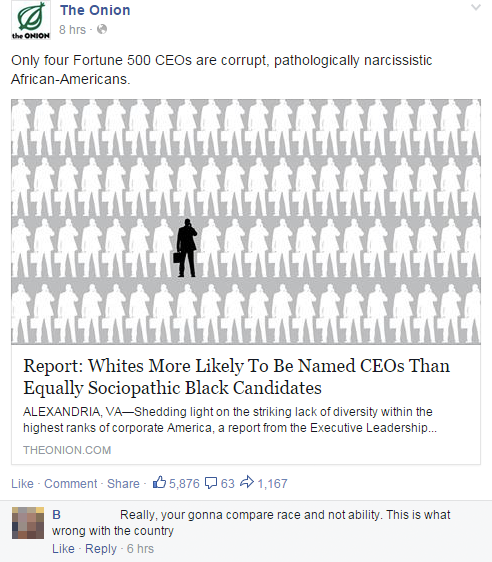 The second issue is created when the author or performer does not let
us in on the joke. The first problem is contextual. What is context? To
be honest, this is a question that is difficult to answer, which is
probably why so many academics spend so much time thinking and writing about it. Context in this instance is the additional information that
the audience needs to understand what is being said. Returning to
Spaceballs for a second, a person who has not watched the Star Wars
films will miss many of the jokes in the film because do not "get" what
the jokes are referencing. What about those of you who have never
watched Star Wars or Spaceballs, you need to understand this stuff too.
The second issue is created when the author or performer does not let
us in on the joke. The first problem is contextual. What is context? To
be honest, this is a question that is difficult to answer, which is
probably why so many academics spend so much time thinking and writing about it. Context in this instance is the additional information that
the audience needs to understand what is being said. Returning to
Spaceballs for a second, a person who has not watched the Star Wars
films will miss many of the jokes in the film because do not "get" what
the jokes are referencing. What about those of you who have never
watched Star Wars or Spaceballs, you need to understand this stuff too.Let's consider people who wear t-shirts "ironically" as another example. One day you see a person walking across campus wearing a Justin Bieber shirt. How do you know if they like Justin Bieber or if they are wearing the shirt "ironically"? Unless you already know that person and their views on Justin Bieber or ask them directly then your do not have the contextual understanding to know for sure. This leads directly to the second part of this issue: the person in the shirt assumes that people will get the "joke" without providing any clues about their intent. If you don't like Justin Bieber but are wearing a shirt with him on it then you better be prepared to spend most of your day explaining your "joke" to people.
Missing the Joke
Surely, this cannot be that much of a problem. Surely, people can easily identify when they are presented with satire. First, don't call me Shirley. Second, people failing to identify satirical content and reacting to it as if it were factual is a problem that seem to only grow each year.The Academy Speaks
In 2009, researchers from The Ohio State University published a study on audience reaction to The Colbert Report. They found that whether the people they polled thought that Stephen Colbert was funny or not, that "conservatives were more likely to to report that Colbert only pretends to be joking and genuinely meant what he said while liberals were more likely to report that Colbert used satire and was not serious when offering political statements. Conservatives also significantly predicted perceptions that Colbert disliked liberalism" (LaMarre, Landreville, and Beam, p.212). In other words, despite the amount of information available that Stephen Colbert was a satirical character some people, likely due to their own political opinions, believed that Colbert's political opinions were earnest.
Obvious jokes are often a great indicator that something is being presented satirically, but what happen when the obvious humor is removed from the equation? While most people can properly identify The Onion as a satirical site because of its use of humor, there are a great many satirical sites on the Internet that use a more decidedly low-key approach. Of course, some people still fall for an Onion article on occasion despite its prominence.
The Press Speaks
In June 2014, New Republic published an article called "The Great Satirical-News Scam of 2014" which examined many of the newer breed of satirical news sites that have gone out of their way to ditch obvious jokes and transparency. Much of the article focused on the Daily Currant, a satirical newsite that was used as a legitimate source by several real news agencies. The article explains that these class of sites purposely hides their true nature so that it is easier for them to generate traffic from outraged people. That traffic equals money for the sites as they get paid every time a user views the plethora of ads on their websites. The end of the article sums up the problem as follows:
"For those who have
fallen for these stories, the consequent humiliation can inoculate them
against making the mistake a second time. But you can’t vaccinate
suckers as fast as they’re born. Unless Google and Facebook change their
algorithms—or humans suddenly become less gullible, and less prone to
confirmation bias—these sites will likely persist, metastasizing across
the internet like a profoundly unfunny cancer" (Link).
Facebook, beginning in August 2014, began testing a system that will tag posts posts from satirical news sites as "satire". These tags will appear in front of the link of items that appear in users' newsfeed. The system is not yet live but there are images of it running that appear from time-to-time. A spokesperson for Facebook the reason for this feature is "because we received feedback that people wanted a clearer way to distinguish satirical articles" (Link). This is similar to a feature available in Google News: "To offer a diversity of opinion and content Google News does contain some satire, often humorous or hyperbolic stories with the intention of social commentary. We identify these types of articles with the tag (satire), so that you'll know when you're reading a satirical article" (Link).
Now What?
Yes, it appears that social media site are making attempts to help clarify a problem that plagues both casual readers and journalism professionals. But is that the only opinion? I'm glad you asked because the answer is a resounding, "No!" Your local or campus library is a great place to learn more about Information Literacy skills. Additionally, it is important to remember to evaluate who wrote something before excepting it at face value. If you find a news story in your social media, follow up on it. Do a Google search for the publication, go to the site and look for links to an "about" or "disclaimer" page, or use a specialized tool like Real or Satire?.
Additional Sources
Gray, J., Jones, J. P., & Thompson, E. (Eds.). (2009). Satire TV: Politics and Comedy in the Post-Network Era. New York and London: New York University Press.
Lamarre, H., Landreville, K., & Beam, M. (2009). The irony of satire: Political ideology and the motivation to see what you want to see in The Colbert Report. International Journal Of Press/Politics, 14(2), 212-231. doi:10.1177/1940161208330904
Image from: http://literallyunbelievable.org/post/113594893209/this-is-what-wrong-with-country
Sunday, April 12, 2015
April 7, 2015 (Tuesday)
Time: 10am-11am (1)
Hours completed (IST): 118/135
Hours completed (Kara Robinson): 15/15
Accumulated on-site hours: 133/150
Today was the first IST meeting that I have been able to attend in awhile. We spent the time discussing the usability testing that we had done previously. Our instructional tech. librarian discussed some of the general things to consider as we determine which skill modules we should update and in what order. She explained that prioritization is very important when updating web-based resources. We spent some time discussing the findings of many members which led to several productive ideas to make the modules better.
I was asked to find a more up-to-date website that we can point to as an example of a hoax site for one of the modules. I will likely look for a few but may also put forward some of the satirical news site that I have been working with as a contender.
I was also asked to conduct more usability tests on some of the other modules if I have the time.
As the current plan is to have these updated by the beginning of fall semester, this is also the planned topic for next week's meeting.
Hours completed (IST): 118/135
Hours completed (Kara Robinson): 15/15
Accumulated on-site hours: 133/150
Today was the first IST meeting that I have been able to attend in awhile. We spent the time discussing the usability testing that we had done previously. Our instructional tech. librarian discussed some of the general things to consider as we determine which skill modules we should update and in what order. She explained that prioritization is very important when updating web-based resources. We spent some time discussing the findings of many members which led to several productive ideas to make the modules better.
I was asked to find a more up-to-date website that we can point to as an example of a hoax site for one of the modules. I will likely look for a few but may also put forward some of the satirical news site that I have been working with as a contender.
I was also asked to conduct more usability tests on some of the other modules if I have the time.
As the current plan is to have these updated by the beginning of fall semester, this is also the planned topic for next week's meeting.
April 2, 2015 (Thursday)
Time: 8am-4pm (8)
Hours completed (IST): 117/135
Hours completed (Kara Robinson): 15/15
Accumulated on-site hours: 132/150
When I first got to the library today I borrowed a book cart from the circulation department and went about selecting books out of reference for the BIs. We have several volumes that dealt specifically with pop culture but I also grabbed several others that were more specific but still related to the topic: volumes on graphic novels, music, general US history, and even baseball.
The first BI went well for the most part. The class itself was very quiet and very resistant to participating much. I managed to get a few people to answer questions and, though less interactive, to laugh a little and raise their hands a few times. Generally, they seemed to understand the information well and during their workshop time I was able to witness several students using the tools and strategies that I suggested for them. The faculty member asked a few questions about how the students could go about getting help from the library: I glossed over that too quickly early on. I think I was worrying about time too much.
After the session was over Tammy told me that everything seemed to go well but she had a few areas that I needed to work on:
Search Example #3
Topic: Gamergate (A recent dispute in the video game community that revolves around female representation and media ethics; it's entire to complex to explain here)
Search String: video (game* OR gaming) AND (gamer gate OR gamergate) AND (media OR journali* OR review*) A quick note: I used (game* OR gaming) because truncating to (gam*) would likely add bad hits.
video (game* OR gaming) [4,332,871 hits]
(gamer gate OR gamergate) [333 hits]
(media OR journali* OR review*) [122 hits]
SPRJ (limiter) [2 hits]
First I explained the necessity of the second part of the string (gamer gate OR gamergate). If I just enter it as "gamer gate," the way that it makes sense to write, then there are no returns. This is because the term is typically written as a hashtag (#term).
I also was able to explain that two hits is likely too few and suggests that the search is either too limited or that there just is not enough out there in the scholarly community. So I showed them how to look for information that is related to their topic but is expressed in entirely new terms. For example, Gamergate is, at least in part, defined by feminist critique:
Search String: video (game* OR gaming) AND femin* AND (media OR journal* OR review*)
SPRJ (limiter)
2010-2015 (date range limiter)
English (language limiter) [218 hits]
This small change provides a much strong base from which to work. In fact, we could still limit this further using Subject limiters. What I wanted them to see was that there were ways to modify searches to get results that will work despite a search not going so well initially. Of course, in this case the initial search may work because the minimum number of scholarly resources needed is two.
The second session went very well, though this group was even more adamant to not participate than the last. I managed to make the changes Tammy suggested and the new search example seemed to make sense to students and, if nothing else, started a lively conversation between myself, Tammy, and the professor.
In a way I like "making mistakes" in front of the students. We spend so much time search databases and so much time preparing for our instruction sessions that we can make searching to effortless or, worse, like magic. People make those comments to me quite often. By show that things can go wrong and that there are ways to fix the situation when it does, I think we make the students less intimidated and, hopefully, more receptive.
Hours completed (IST): 117/135
Hours completed (Kara Robinson): 15/15
Accumulated on-site hours: 132/150
When I first got to the library today I borrowed a book cart from the circulation department and went about selecting books out of reference for the BIs. We have several volumes that dealt specifically with pop culture but I also grabbed several others that were more specific but still related to the topic: volumes on graphic novels, music, general US history, and even baseball.
The first BI went well for the most part. The class itself was very quiet and very resistant to participating much. I managed to get a few people to answer questions and, though less interactive, to laugh a little and raise their hands a few times. Generally, they seemed to understand the information well and during their workshop time I was able to witness several students using the tools and strategies that I suggested for them. The faculty member asked a few questions about how the students could go about getting help from the library: I glossed over that too quickly early on. I think I was worrying about time too much.
After the session was over Tammy told me that everything seemed to go well but she had a few areas that I needed to work on:
- I needed to explain the VPN in greater detail, mainly to distinguish that students only needed to download the software once but need to activate it every time they want to connect to resources off campus
- She mentioned how I needed to better explain the ways that students could contact the library for help. She was pleased that the professor saved me on that one but I needed to remember to do it myself.
- My lesson plan for using the two searches (general and specific) works really well; however, in my hypothetical "I am a fellow student" presentation I called myself an "bad student" when explaining the general search. She rightly reminded me that might be off-putting to students. She suggested that I reframe it as being undecided about my topic which is much better and much closer to what I am trying to explain to them.
- I need to remember to show the students how to find the subject databases even if they aren't going to be using them during the session. She explained that this may be the only time a student gets library training for a long time, if ever, and it's important to introduce them to these tools when we have the chance.
- I need to spend more time talking about the tools available in Discovery: email, permalink, folders, etc.
Search Example #3
Topic: Gamergate (A recent dispute in the video game community that revolves around female representation and media ethics; it's entire to complex to explain here)
Search String: video (game* OR gaming) AND (gamer gate OR gamergate) AND (media OR journali* OR review*) A quick note: I used (game* OR gaming) because truncating to (gam*) would likely add bad hits.
video (game* OR gaming) [4,332,871 hits]
(gamer gate OR gamergate) [333 hits]
(media OR journali* OR review*) [122 hits]
SPRJ (limiter) [2 hits]
First I explained the necessity of the second part of the string (gamer gate OR gamergate). If I just enter it as "gamer gate," the way that it makes sense to write, then there are no returns. This is because the term is typically written as a hashtag (#term).
I also was able to explain that two hits is likely too few and suggests that the search is either too limited or that there just is not enough out there in the scholarly community. So I showed them how to look for information that is related to their topic but is expressed in entirely new terms. For example, Gamergate is, at least in part, defined by feminist critique:
Search String: video (game* OR gaming) AND femin* AND (media OR journal* OR review*)
SPRJ (limiter)
2010-2015 (date range limiter)
English (language limiter) [218 hits]
This small change provides a much strong base from which to work. In fact, we could still limit this further using Subject limiters. What I wanted them to see was that there were ways to modify searches to get results that will work despite a search not going so well initially. Of course, in this case the initial search may work because the minimum number of scholarly resources needed is two.
The second session went very well, though this group was even more adamant to not participate than the last. I managed to make the changes Tammy suggested and the new search example seemed to make sense to students and, if nothing else, started a lively conversation between myself, Tammy, and the professor.
In a way I like "making mistakes" in front of the students. We spend so much time search databases and so much time preparing for our instruction sessions that we can make searching to effortless or, worse, like magic. People make those comments to me quite often. By show that things can go wrong and that there are ways to fix the situation when it does, I think we make the students less intimidated and, hopefully, more receptive.
Subscribe to:
Posts (Atom)